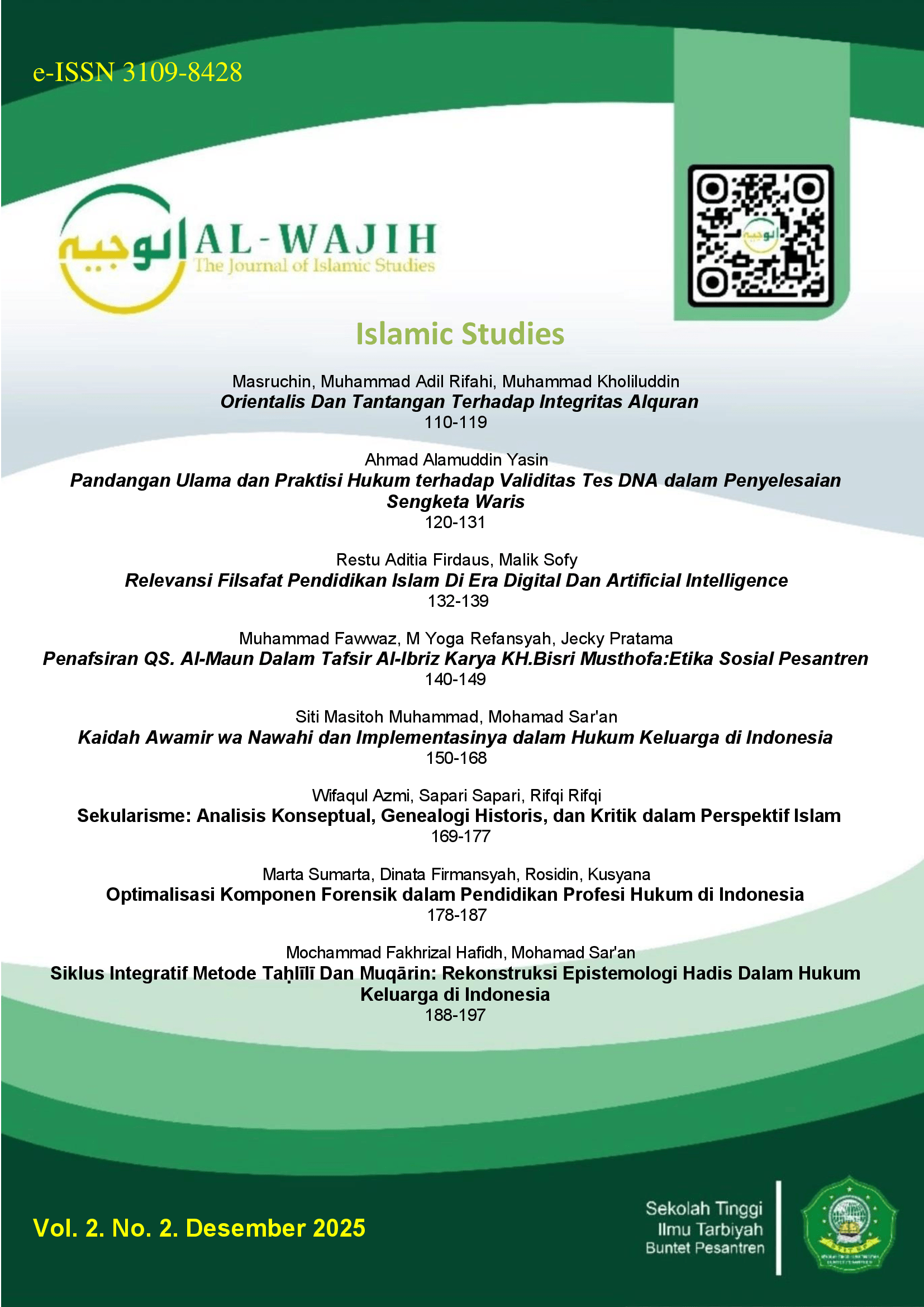
Pandangan Ulama dan Praktisi Hukum terhadap Validitas Tes DNA dalam Penyelesaian Sengketa Waris
DOI:
https://doi.org/10.54213/g4k28735Abstract
This study aims to explore scholars’ perceptions regarding the validity of DNA testing in resolving inheritance disputes from the perspective of Islamic law. The research involves scholars from two groups: the Indonesian Council of Ulama (MUI) and pesantren-based scholars. It employs a qualitative descriptive method, using primary data collected through in-depth interviews and secondary data from legal documents and relevant literature. The data were analyzed through processes of data reduction, presentation of findings, and conclusion drawing. The results indicate that the use of DNA testing in inheritance disputes is a complex issue that requires caution. Although recognized as a scientifically valid and accurate form of evidence, DNA tests cannot serve as the sole basis for legal decisions. They must be viewed as part of an overall body of evidence and integrated with Sharia principles that prioritize justice, public benefit, and the preservation of family dignity. Scholars from MUI and KH. Ahmad Rifqi Chowas from the pesantren community stress that while technologies like DNA testing offer high accuracy in determining biological relationships, their use must be prudent and aligned with Sharia principles. In conclusion, DNA testing has significant potential as a supporting tool in resolving inheritance disputes, but its application must be carried out with great care. Religious courts and policymakers need to develop clear guidelines on when and how DNA testing may be used, ensuring that its integration is consistent with Sharia values and does not lead to injustice or social discord.
Downloads
References
Afifah, H. (2020). Tinjauan Hukum Islam Terhadap Tes DNA Sebagai Alat Bukti Tindak Pidana Pembunuhan. Tinjauan Hukum Islam, 16(2), 27–43. https://doi.org/https://doi.org/10.37035/ajh.v16i2.3614
Agusti, H. W. N. (2024). Penentuan Keturunan dengan Menggunakan DNA pada Tulang Belulang Jenazah : Systematic Review. Plexus Medical Journal, 3(2), 54–66. https://doi.org/10.20961/plexus.v3i2.379
Al-Bukhārī, A. ‘Abdullāh M. ibn I. (2002). Ṣaḥīḥ al-Bukhārī. In al jami’ al musnad as shahih.
Ali, B., Wulandari, N., & Erianti, N. (2024). Status of Children Born Out of Wedlock: A Study of Constitutional Court Decision and Its Relevance to the View of Ibnu Taimiyah. El-Usrah, 7(1), 406–426. https://doi.org/10.22373/ujhk.v7i1.24200
Anwar, M. R., & Musip, M. (2024). Li ’ an Suami Sebagai Cara Mencegah Sanksi Menuduh Zina dari Perspektif Medis dan HAM. At-Tahdzib: Jurnal Studi Islam Dan Mu’amalah, 3(2), 54–62. https://doi.org/https://doi.org/10.61181/at-tahdzib.v12i1.336
Ardandi, R. Y., Nurhaliza, S., Maykania, P., Sha, N. P., Himayani, R., & Rahmanisa, S. (2024). Penerapan DNA Rekombinan Dalam Terapi Gen : Vaksin DNA SARS-CoV-2 dan Terapi Kanker Application of Recombinant DNA in Gene Therapy : SARS-CoV-2 DNA Vaccine and Cancer Therapy. Medical Profession Journal of Lampung, 14(86), 895–900. https://doi.org/https://doi.org/10.53089/medula.v14i5.930
Aslati, Agustar, A., Silawati, Arisman, & Arafah, S. (2024). Utilizing Science and Maqāṣid al-Sharī’ah in Resolving Contemporary Issues of Islamic Family Law. Al-Manahij: Jurnal Kajian Hukum Islam, 18(1), 17–36. https://doi.org/10.24090/mnh.v18i1.10571
Bahrudin, R. (2020). Metode Al-Qiyafah Ibnu Qayyim al-Jauziyyah dalam Penetapan Nasab Serta Relevansinya Dengan Tes DNA [UIN Syarif Hidayatullah]. https://repository.uinjkt.ac.id/dspace/handle/123456789/51805%0Ahttps://repository.uinjkt.ac.id/dspace/bitstream/123456789/51805/1/RIDWAN BAHRUDIN-FSH.pdf
Clark-Boucher, D., Zhou, X., Du, J., Liu, Y., Needham, B. L., Smith, J. A., & Mukherjee, B. (2023). Methods for mediation analysis with highdimensional DNA methylation data: Possible choices and comparisons. PLoS Genetics, 19(11 November), 1–26. https://doi.org/10.1371/journal.pgen.1011022
Fadel, M. (2022). “DNA Evidence and the Islamic Law of Paternity in Light of Maqāṣid al-Sharīʿa.” Muslim World, 112(3). https://doi.org/10.1111/muwo.12441
Fragoso-Bargas, N., Elliott, H. R., Lee-ødegård, S., Opsahl, J. O., Sletner, L., Jenum, A. K., Drevon, C. A., Qvigstad, E., Moen, G. H., Birkeland, K. I., Prasad, R. B., & Sommer, C. (2023). Cross-Ancestry DNA Methylation Marks of Insulin Resistance in Pregnancy: An Integrative Epigenome-Wide Association Study. Diabetes, 72(3), 415–426. https://doi.org/10.2337/db22-0504
Futuhaat, H., & Priyono, E. A. (2023). Hukum Pidana Terkait Tes DNA Korban dalam Rangka Pembuktian terhadap Kejahatan Mutilasi. Jurnal Ilmiah Universitas Batanghari Jambi, 23(1), 894. https://doi.org/10.33087/jiubj.v23i1.2933
Hanapi, A., Achyar, G., & Zulhamidi, N. N. S. B. (2024). Husband’s Rejection To Children’s Lineage After Divorce. El-Hadhanah: Indonesian Journal Of Family Law And Islamic Law, 4(1), 105–118. https://doi.org/https://doi.org/10.22373/hadhanah.v4i1.3711
Hannum, S. (2023). Penentuan Nasab Melalui Tes DNA Perspektif Hukum Islam (Ditinjau Dari Maqoshid Syariah). JRP: Jurnal Relasi Publik, 1(4), 174–191. https://doi.org/https://doi.org/10.59581/jrp-widyakarya.v1i4.1844
Harland, S. R. (2023). Hak Waris Anak Hasil Surogasi Menurut Peraturan Perundang–Undangan di Indonesia. Journal Evidence Of Law, 2(3), 17–23. https://doi.org/10.59066/jel.v2i3.468
Herman, Sunardi, & Famuji, T. S. (2023). Proses Implementasi Bioinformatika Pada Digitalisasi Data Genetika Manusia. Simetris: Jurnal Teknik Mesin, Elektro Dan Ilmu Komputer, 14(1), 1–12. https://doi.org/10.24176/simet.v14i1.9064
Luo, M., Ji, Y., Warton, D., & Yu, D. W. (2023). Extracting abundance information from DNA-based data. Molecular Ecology Resources, 23(1), 174–189. https://doi.org/10.1111/1755-0998.13703
Muhajir, A., & Alatas, A. (2023). The Debate on the Ba’Alawi Lineage in Indonesia: Highlighting Weaknesses in the Genealogical Records. ISEAS-Yusof Ishak Institute.
Nawawi, R. (2023). Genealogi Kiai Jawa (Studi Sanad Keilmuan dan Nasab Kiai Pondok Pesantren Jampes). Jurnal Kajian Islam Interdisipliner, 8(2), 1–28. https://doi.org/https://doi.org/10.14421/jkii.v9i1.1365
Padmanabhan, A. S., & Sapna, S. (2023). Forensic Investigation Approaches of DNA Analysis and Criminal Investigation. International Journal of Safety and Security Engineering, 13(1), 129–137. https://doi.org/10.18280/ijsse.130115
Prayogi, Hasibuan, L. M., Tarigan, N., Nur, H., & Rahmadina. (2024). Amitosis , Mitosis dan Meiosis Meteri Genetika dan Replika DNA. 4(3), 16414–16422. https://doi.org/https://doi.org/10.31004/innovative.v4i3.12116
Putri, A., & Nasution, M. I. (2023). Penerapan Database DNA Dalam Mengungkap Kasus Kriminal. IJM: Indonesian Journal of Multidisciplinary, 1(4), 1283–1291.
Radindi, N. A. (2023). Pemberian Wasiat Wajibah Bagi Anak Luar Kawin Dalam Hukum Islam. Jurnal Hukum Ius Publicum, 4(2), 76–88. https://doi.org/10.55551/jip.v4i2.68
Rahayu, T. Q., & Pertiwi, A. P. (2022). Peran Tes DNA terhadap Kedudukan Status Anak Li’an dari Hasil Perkawinan yang Sah Ditinjau dari Perspektif Hukum Islam dan Hukum Positif di Indonesia. Jurnal Hukum Lex Generalis, 3(2), 148–166. https://doi.org/https://doi.org/10.56370/jhlg.v3i2.181
Salami, U., & Abidah, A. (2021). Perspsi Syarifah Di Hidayatullah Balikpapan Tentang Syarifah Yang Menikah Dengan Laki-Laki Non Sayyid. Ulumul Syar’i : Jurnal Ilmu-Ilmu Hukum Dan Syariah, 9(1). https://doi.org/10.52051/ulumulsyari.v9i1.82
Surur, A. M., Anfa’u, M., Rosi, F., & Rohmain, M. A. F. (2024). Memudarnya Otoritas Keagamaan? ( Polemik Nasab Habaib di Kalangan Pondok Pesantren Al-Nahdliyin ). Asy-Syari`ah: Jurnal Hukum Islam, 10(1), 33–47. https://doi.org/https://doi.org/10.55210/assyariah.v10i1.1542
Yasin, A. A. (2021). Hak Waris Anak Angkat dalam Pespektif Undang-Undang dan Hukum Islam. Tsaqafatuna, 3(1). https://doi.org/10.54213/tsaqafatuna.v3i1.60
Yorita, S., Sofyan, A., Astrid Zalsa Yulinda, S Safitri, E Ernawati, & H Hardiani. (2023). Tinjauan Yuridis Status Anak Di Bawah Tangan Dalam Hak Menerima Warisan. Athena: Journal of Social, Culture and Society, 1(1), 26–32. https://doi.org/10.58905/athena.v1i1.5
 Focus & Scopes
  Author Guidelines
  Peer Review Process
  Publication Ethics & Malpractice
  Contact
  Reviewer Team
  Editorial Team
  Template Document
  Article Processing Charge
  Copyright Notice
 Open Access Policy