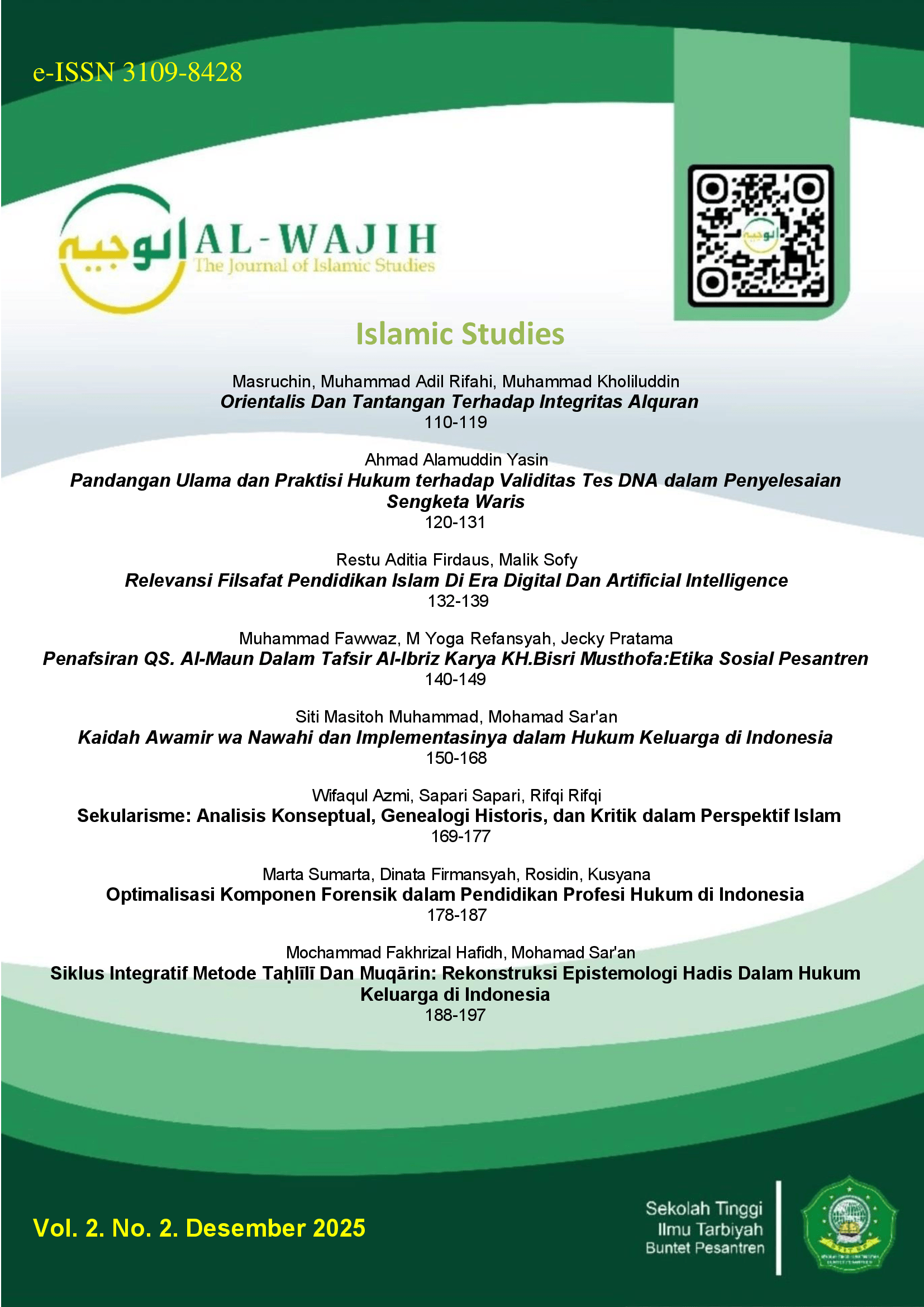
Relevansi Filsafat Pendidikan Islam Di Era Digital Dan Artificial Intelligence
DOI:
https://doi.org/10.54213/z2ca8j06Keywords:
Islamic educational philosophy, Artificial Intelligence, digital era, adab, Islamic educationAbstract
The rapid development of digital technology and Artificial Intelligence (AI) has brought fundamental changes to educational systems and learning practices. While technological advancement offers efficiency, flexibility, and broader access to information, it also raises serious ethical and philosophical concerns, including moral degradation, academic dishonesty, and the reduction of education to mere technical skill acquisition. This article aims to examine the relevance of Islamic educational philosophy in addressing the challenges of education in the digital and AI era. This study employs a library research method with a descriptive-analytical approach by examining the ideas of prominent Islamic educational philosophers such as Al-Ghazali, Syed Muhammad Naquib al-Attas, and Ibn Khaldun. The findings indicate that Islamic educational philosophy, through the concepts of ta’lim, tarbiyah, and ta’dib, provides a comprehensive ethical and philosophical framework for guiding the responsible use of educational technology. By emphasizing adab and spiritual values as the core of education, Islamic educational philosophy remains highly relevant in shaping knowledgeable, ethical, and socially responsible individuals in the era of digital transformation.
Downloads
References
Abbas, F. M. (2024). Etika Islam: Telaah buku “Antara Al-Ghazali dan Kant: Filsafat Etika Islam.” Indonesian Journal of Islamic Theology and Philosophy, 6(1), 57–72.
Abbas, F. M. (2025). Artificial Intelligence, Academic Ethics, and the Transformation of Learning in Higher Education (Kecerdasan Artifisial, Etika Akademik, dan Transformasi Pembelajaran di Perguruan Tinggi). Lentera Pendidikan: Jurnal Ilmu Pendidikan Dan Keguruan Islam, 1(4), 173–183.
Al-Attas, S. M. N. (1993). Islam and Secularism. Kuala Lumpur: International Institute of Islamic Thought and Civilization (ISTAC).
Al-Ghazali, A. H. (2000). Ihya’ Ulum al-Din. Beirut: Dar al-Kutub al-Ilmiyyah.
Anwar, S. (2022). Evaluasi Pendidikan Menuju Insan Kamil Perspektif Filsafat Islam. Jurnal Pendidikan Nusantara, 1(1), 62-76.
Basori, B., Pasaribu, M. Y., & Amalya, R. N. (2025). Filsafat Pendidikan Islam: Integrasi Nilai-Nilai Spiritual dalam Sistem Pendidikan Modern. Reflection: Islamic Education Journal, 2(2), 256-268.
Brutu, D., Annur, S., & Ibrahim, I. (2023). Integrasi Nilai Filsafat Pendidikan Dalam Kurikulum Merdeka Pada Lembaga Pendidikan Islam. Jambura Journal of Educational Management, 442-453.
Faiz, F., Ula, N. F., & Zubaidi, A. (2022). Relasi etika dan teknologi dalam perspektif filsafat islam. TRILOGI: Jurnal Ilmu Teknologi, Kesehatan, Dan Humaniora, 3(3).
Ibnu Khaldun. (2004). Muqaddimah Ibnu Khaldun. Beirut: Dar al-Fikr.
Moleong, L. J. (2018). Metodologi Penelitian Kualitatif. Bandung: Remaja Rosdakarya.
Mutahhari, M. (2002). Understanding Islamic Sciences. London: ICAS Press.
Jw, C. (2009). Research design-qualitative, quantitative, and mixed methods approaches. SAGE, Ca; Ofprnia.
Romdon, M. R. (2025). Tafsir Mauḍu’i Sebagai Pendekatan Penelitian Kualitatif (Teori Dan Aplikasi). Al-Wajih: The Journal of Islamic Studies, 2(1), 12-28.
Sugiyono. (2017). Metode Penelitian Pendidikan: Pendekatan Kualitatif, Kuantitatif, dan R&D. Bandung: Alfabeta.
Yusuf, I. A., & Abbas, F. M. (2025). Inovasi kurikulum pendidikan Islam di perguruan tinggi: Integrasi tauhid, sains, dan teknologi. HASBUNA: Jurnal Pendidikan Islam, 7(2), 142–152.
Zed, M. (2014). Metode Penelitian Kepustakaan. Jakarta: Yayasan Pustaka Obor Indonesia.
 Focus & Scopes
  Author Guidelines
  Peer Review Process
  Publication Ethics & Malpractice
  Contact
  Reviewer Team
  Editorial Team
  Template Document
  Article Processing Charge
  Copyright Notice
 Open Access Policy