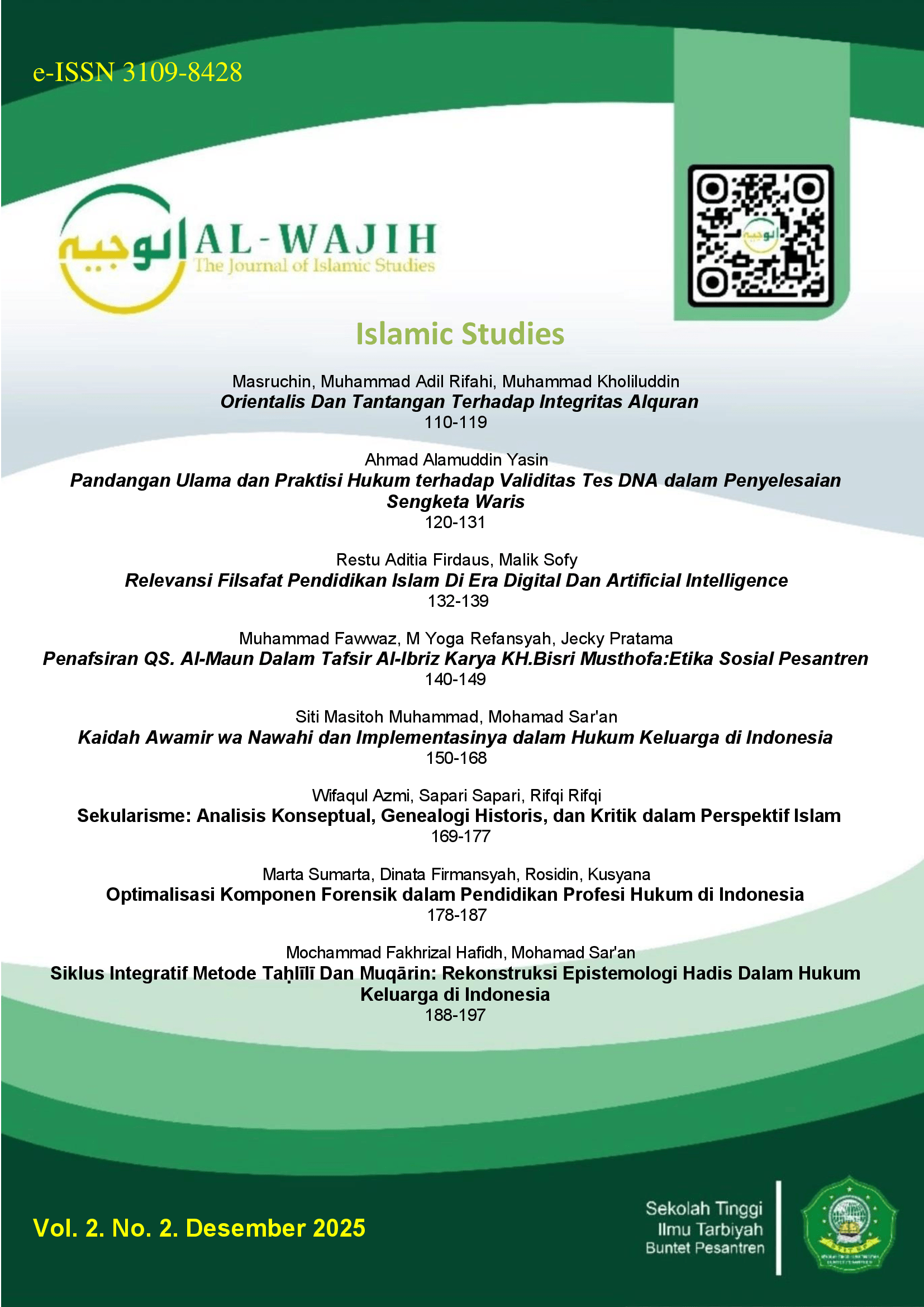
Orientalis Dan Tantangan Terhadap Integritas Alquran
DOI:
https://doi.org/10.54213/gfv5cz06Keywords:
Orientalis; Kritik filologi; Qira'at; Integritas teksAbstract
The study of the Qur'ān is not only conducted by Muslim scholars, but also by Western scholars known as orientalists. This study aims to critically analyze the challenges posed by orientalists to the integrity of the Qur'ān, focusing on four main issues: claims of influence from previous religious texts, the Qur'ānic codification process, variations in recitation (qira'at), and the authenticity of language and text structure. The method used in this research is a qualitative study with a literature approach, namely through a critical review of the works of orientalist figures such as Abraham Geiger, John Wansbrough, Richard Bell, and Arthur Jeffery, as well as comparisons from the views of Muslim scholars such as M.M. Al-Azami and Toshihiko Jeffery. Al-Azami and Toshihiko Izutsu. The results show that although orientalists have contributed to opening up a space for academic dialogue about the Qur'ān, many of their claims contain methodological biases and historical assumptions that do not consider the context of Islamic revelation. On the other hand, Islamic scholarly tradition shows that the Qur'ān has undergone a systematic codification process since the time of the Prophet Muhammad, and that variations in recitation (qira'at) are part of the linguistic richness that remains within the framework of Islamic orthodoxy.
Downloads
References
Abbas, F. M. (2019). Studi Tafsir Kontemporer: Telaah Buku “Alqur’an Kitab Sastra Terbesar”. dalam Tsaqafatuna: Jurnal Ilmu Pendidikan Islam, 1(2), 80-88.
Ahmad, K. & Zitawi, J. (2022). Orientalist Approaches to the Qur’an: A Critical Review. Journal of Islamic Studies, 33(2).
Akmal, M. I. (2024). Pemikiran Amin Abdullah Seputar Integrasi Keilmuan. Fathir: Jurnal Studi Islam, 1(2). https://doi.org/10.71153/fathir.v1i2.13
al-Qaththan, M. (1973). Mabahits fi Ulum al-Qur’an. Manshurah al-Ashr al-Hadits.
Alaydrus, A., Jamal, Muh., & Nurmiyati, N. (2023). Pengawasan Pemilu: Membangun Integritas, Menjaga Demokrasi. Penerbit Adab.
Al-Azami, M. M. (2003). The History of the Qur’anic Text: From Revelation to Compilation. UK Islamic Academy.
Anshori, M. (2018). Tren-Tren Wacana Studi Al-Qur’an dalam Pandangan Orientalis di Barat. NUN; Jurnal Studi Alquran dan Tafsir di Nusantara, 4(1).
Athar, M. (2024). Kritik Orientalisme terhadap Al-quran Analisis dan Tanggapan Sarjana Musllim. Fikroh: Jurnal Studi Islam, 8(1). https://doi.org/10.37216/fikroh.v8i1
Azmi, A. S. (2019). Kritikan Orientalis Terhadap Keaslian Bahasa al-Quran: Analisis Terhadap Teori Perkataan Asing dalam al-Quran. Journal of Ma’alim al-Quran wa al-Sunnah, 15(2). https://doi.org/10.33102/jmqs.v15i2.198
Bahiy, M. (1981). Pemikiran Islam Kontemporer dan Hubungannya dengan Kolonialisme Bara. Maktabah Wahbah.
Bell, R. (1937). The Qur’an: Translated, with a Critical Re-arrangement of the Surahs. T&T Clark.
Fu‟aad, A. (2001). Min Iftira‟aat al-Mustasyriqin „Ala al-Ushul al-Aqidah fi al-Islam. Maktabah al-Ubaikaan.
Geiger, A. (1988). Judaism and Islam (F. M. Young, Penerj.). M.D.C.S.P.C.K. Press. Https://dictionary.cambridge.org/dictionary/english/integrity.(t.t.) Https://languages.oup.com/google-dictionary-en/. (t.t.).
Ghofur, M. A. (2024). Sejarah dan Dinamika Perkembangan Wacana Kronologi Al-Qur'an Kaum Orientalis. AN NUR: Jurnal Studi Islam, 16(1), 164-178.
Huda, M. N., & Huda, K. (2024). Harmonisasi Agama dan Kemajuan: Manfaat Integrasi Keilmuan Islam dalam Era Kontemporer. Journal of Islamic Education, 6(1). https://doi.org/10.18860/jie.v11i1.24012
Ismail, D., Rahman, A. A., Khairuldin, W. M. K. F. W., & Thoarlim, A. (2018). [Misunderstanding Orientalis to Rasm Mushaf Uthmani] Salah Faham Orientalis Terhadap Rasm Mushaf Uthmani. Journal of Qur’anic Research, 12(1). https://doi.org/10.37231/jimk.2018.18.1.296
Isti’ana, A. (2024). Integrasi Teknologi dalam Pembelajaran Pendidikan Islam. Indonesian Research Journal on Education, 4(1). https://doi.org/10.31004/irje.v4i1.493
Izutsu, T. (1966). Ethico-Religious Concepts in the Qur’an. McGill University Press.
Jeffery, A. (1937). Materials for the History of the Text of the Qur’an. Brill.
John, & Shadily, H. (1996). Kamus Inggris Indonesia. Gramedia.
KBBI. (2007). Kamus Besar Bahasa Indonesia. Balai Pustaka.
Mursyid, A. Y. (2021). Paradigma Penelitian Manuskrip Al-Qur’an: Dari Diskursus ke Metodologi. Islamika: Jurnal Ilmu-ilmu Keislaman, 21(2). https://doi.org/10.32939/islamika.v21i02.817
Nisak, K., Riza, S., & Amiruddin. (2023). Pentingnya Trasparansi Keuangan Negara Dalam Meningkatkan Integritas dan Meminimalisir Tindak Pidana Korusi di Suatu Negara. Ameena Journal, 1(2). https://doi.org/10.63732/aij.v1i2.26
Qorib, M., Akrim, & Gunawan. (2020). Integrasi Etika Dan Moral | Spirit dan Kedudukannya dalam Pendidikan Islam. Kumpulan Berkas Kepangkatan Dosen,. https://publication.umsu.ac.id/index.php/ht/article/view/124
Raymond W. Cox III (Ed.). (2015). Ethics and Integrity in Public Administration. Routledge.
Said, E. W. (1978). Orientalism. Pantheon Books.
Susmihara. (2017). Sejarah Perkembangan Orientalis. Rihlah: Jurnal Sejarah dan Kebudayaan, 5(1). https://doi.org/10.24252/rihlah.v5i1.3182
Syu’eb, Y. (1990). Orientalisme dan Islam. Bulan Bintang.
Teng, M. B. A. (2016). Orientalis Dan Orientalisme Dalam Perspektif Sejarah. Jurnal Ilmu Budaya, 4(1). https://doi.org/10.34050/jib.v4i1.2324
Wansbrough, J. (1977). Quranic Studies: Sources and Methods of Scriptural Interpretation. Oxford University Press.
 Focus & Scopes
  Author Guidelines
  Peer Review Process
  Publication Ethics & Malpractice
  Contact
  Reviewer Team
  Editorial Team
  Template Document
  Article Processing Charge
  Copyright Notice
 Open Access Policy